Key Takeaways
- Pinpoint the macro-forces and core technology categories creating generational investment opportunities in the health sector.
- Gain a forward-looking perspective on the frontier technologies, such as generative AI and bioinformatics, that are set to define the next wave of innovation.
- Understand the unique landscape of the Australian digital health ecosystem to identify strategic entry points and partnership opportunities.
- Master the key commercialisation challenges specific to healthtech, from navigating regulatory pathways to building a capital-efficient business model.

For founders and innovators, the term digital health can feel less like a defined sector and more like a collection of buzzwords. This ambiguity presents a critical challenge: how do you articulate your venture's value to investors, navigate complex regulatory pathways, and build a capital-efficient business when the landscape itself seems undefined? The line between a genuine market opportunity and a fleeting trend can appear dangerously thin, leaving even the most visionary founders struggling to position their ideas for success.
This comprehensive guide is engineered to cut through that noise. We deconstruct the digital health ecosystem, moving beyond broad definitions to provide a structured framework of its core components and most significant investment theses. You will gain a clear understanding of the key trends shaping the future of healthcare, identify the most promising sub-sectors for innovation, and grasp the unique dynamics of the Australian market. Our objective is to equip you with the strategic intelligence required to confidently articulate your venture's position and build the future of healthcare.
Deconstructing Digital Health: The Core Categories of Innovation
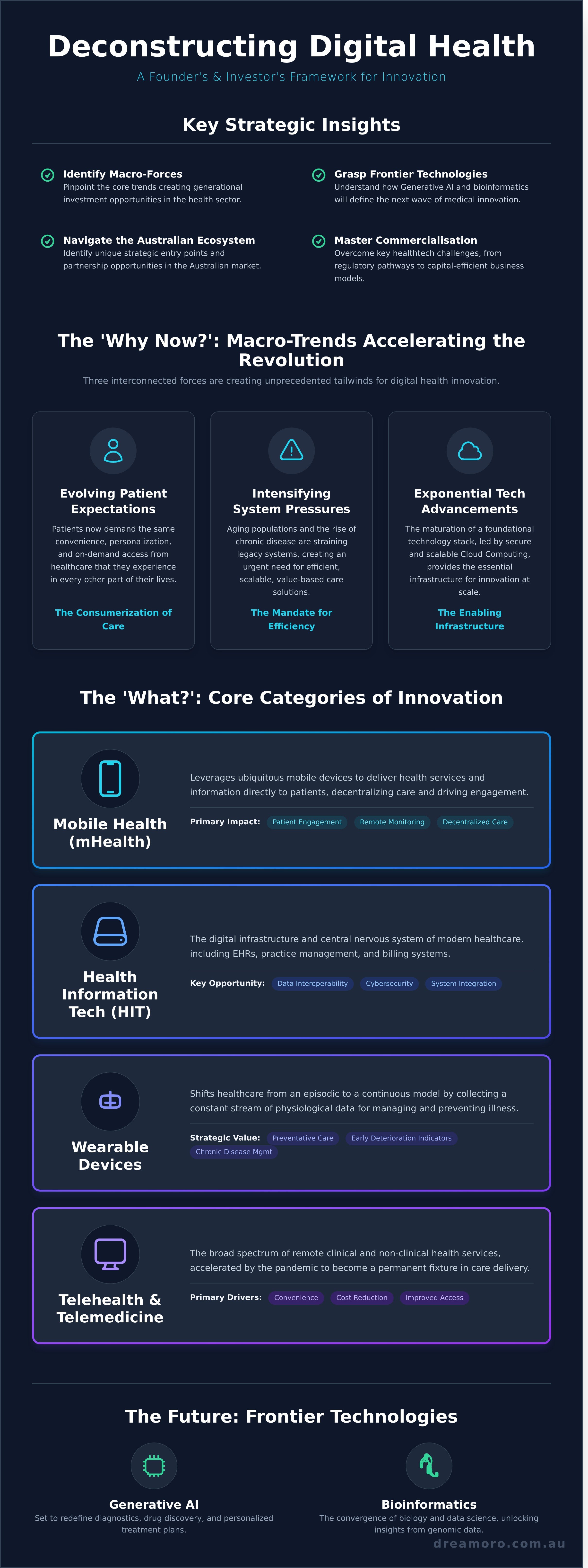
At its core, digital health represents the fundamental convergence of healthcare services, technology platforms, and patient empowerment. It is not a single product but a vast, interconnected ecosystem where digital tools are leveraged to improve health outcomes, enhance operational efficiency, and democratize access to care. For founders and investors navigating this landscape, understanding the answer to "What is Digital Health?" means dissecting its primary domains of innovation. These categories, while distinct, are increasingly interdependent, creating powerful opportunities at their intersections.
Mobile Health (mHealth)
mHealth leverages the ubiquity of mobile devices to deliver health services and information directly to the patient. This domain encompasses everything from wellness and meditation apps to sophisticated platforms for remote patient monitoring and digital medication reminders. Its primary impact lies in decentralizing care, driving unprecedented levels of patient engagement, and extending the reach of healthcare far beyond the clinic walls.
Health Information Technology (HIT)
HIT is the digital infrastructure-the central nervous system-of the modern healthcare system. This category is dominated by Electronic Health Records (EHRs), practice management software, and systems for billing and revenue cycle management. For founders, the most significant opportunities lie in solving the persistent challenges of data interoperability and security, creating platforms that allow seamless and secure information exchange across the entire care continuum.
Wearable Devices
Wearable technology shifts healthcare from an episodic to a continuous model by collecting a constant stream of physiological data. This includes consumer-grade devices like smartwatches tracking activity and heart rate, as well as clinical-grade sensors for managing chronic conditions like diabetes or cardiac arrhythmias. The strategic value of wearables is their potential to power preventative care models and provide early indicators of health deterioration.
Telehealth and Telemedicine
While often used interchangeably, telehealth refers to the broad spectrum of remote health services, whereas telemedicine is specific to clinical services delivered by a physician. Accelerated by the COVID-19 pandemic, this category has become a permanent fixture in the healthcare delivery model. Its growth is fueled by its ability to provide unparalleled convenience, reduce costs, and dramatically improve patient access to both general practitioners and specialists.
The Macro-Trends Accelerating the Digital Health Revolution
The rapid ascent of digital health is not a product of a single innovation but the result of a powerful confluence of forces. Understanding this paradigm shift is critical for founders aiming to build enduring companies in this space. Three distinct yet deeply interconnected macro-trends are creating unprecedented tailwinds: evolving patient expectations, immense systemic pressures on traditional healthcare, and the exponential maturation of enabling technologies. This convergence is the definitive answer to the 'why now?' question, creating a fertile ground for disruption and value creation.
Evolving Patient Expectations: The Consumerization of Care
Today's patients are consumers, conditioned by on-demand, personalized experiences in every other facet of their lives. They now expect the same from healthcare: convenience, price transparency, and frictionless access to care and personal health data. This shift away from passive patienthood toward active health consumerism is a primary catalyst. Digital tools, from telehealth platforms to remote monitoring devices, are perfectly positioned to meet this demand, delivering care where and when the consumer needs it.
Intensifying Healthcare System Pressures: The Mandate for Efficiency
Legacy healthcare systems globally are strained by the twin challenges of aging populations and the escalating burden of chronic disease. The traditional fee-for-service model is proving economically unsustainable. This has accelerated the strategic shift toward value-based care, which incentivizes outcomes over volume. Digital health offers the core toolkit for this new model, providing scalable solutions for preventative care, chronic disease management, and operational efficiency that legacy systems simply cannot match.
Exponential Technological Advancements: The Enabling Infrastructure
The current revolution would be impossible without a mature technology stack providing the foundational infrastructure for innovation at scale. Key advancements include:
- Cloud Computing: Providing the secure, scalable, and interoperable backbone required to manage colossal health datasets, from electronic health records to genomic sequences.
- AI and Machine Learning: Unlocking predictive insights from complex data, powering everything from advanced diagnostics to personalized treatment pathways and creating new categories of medical tools that align with the FDA's Definition of Digital Health.
- Ubiquitous Connectivity: The proliferation of smartphones and wearables has transformed every individual into a potential source of real-time health data, opening a new frontier for continuous monitoring and patient engagement.
These forces are not independent; they are a reinforcing flywheel. As technology enables better patient experiences, it simultaneously provides the tools to address systemic pressures, creating a generational opportunity for the founders building the future of healthcare.
Frontier Technologies: Defining the Future of Medicine
While established categories like telehealth have digitised existing care models, the true frontier of digital health lies in technologies that fundamentally re-architect the system. These emerging, high-growth domains represent the core of Medicine 3.0-a paradigm shift from reactive treatment to proactive, personalised, and predictive care. For founders and investors, these frontiers are not just areas of innovation; they are the platforms for building category-defining companies with the potential for transformative impact on patient outcomes.
Preventative Health Technology
The most effective intervention is the one that prevents an illness from ever occurring. Preventative health technology embodies this proactive philosophy, leveraging data to identify risks and empower individuals to maintain wellness. This includes everything from advanced genetic screening that flags predispositions to chronic disease, to continuous monitoring and lifestyle management platforms that guide daily behaviour. The economic thesis is compelling: preventing disease is exponentially more capital-efficient and socially beneficial than treating it.
Digital Therapeutics (DTx)
Digital Therapeutics represent a new class of medicine, delivering evidence-based therapeutic interventions directly to patients via software. Unlike general wellness apps, DTx platforms must undergo rigorous clinical trials and secure regulatory approval to treat, manage, or prevent a medical condition. As detailed in scholarly reviews on Digital Health in Clinical Practice, these solutions can augment traditional pharmaceuticals or, in some cases, serve as standalone, prescription-based therapies for conditions ranging from chronic insomnia to substance use disorder.
AI in Diagnostics and Personalised Medicine
Artificial intelligence is the engine driving the shift towards truly personalised care. By analysing massive, complex datasets far beyond human capacity, AI is revolutionising diagnostics and treatment planning.
Key applications include:
- Enhanced Diagnostics: AI algorithms can detect subtle patterns in medical imaging and pathology data, enabling earlier and more accurate diagnoses of cancers and other diseases.
- Personalised Treatment: AI models can analyse an individual’s genomic data, lifestyle factors, and clinical history to predict their response to different therapies, tailoring treatments for maximum efficacy.
This capacity for deep, data-driven intelligence is precisely why AI-first companies are a cornerstone of our investment thesis, creating the foundational models for the future of medicine.
The Australian Digital Health Ecosystem: A Landscape of Opportunity
Australia presents a unique and fertile ground for founders building the future of healthcare. A sophisticated blend of government support, a deeply collaborative research and commercialisation network, and a maturing investment landscape creates a powerful launchpad for world-class digital health innovation.
Key Government Initiatives and Regulatory Bodies
Support for healthtech is embedded at a structural level. The national My Health Record system provides a foundational, albeit evolving, data infrastructure. Critically, the Therapeutic Goods Administration (TGA) has established a clear regulatory framework for Software as a Medical Device (SaMD), providing a defined pathway to market. This is complemented by the federal R&D Tax Incentive, which offers a significant source of non-dilutive capital for startups-a crucial lifeline in the early stages.
The Rise of Healthtech Hubs and Accelerators
Innovation is concentrated in vibrant hubs across Sydney, Melbourne, and Brisbane, often anchored by leading universities and medical research institutes. Specialist organisations and dedicated accelerators are pivotal in translating research into commercial success, offering bespoke acceleration programs. Deep-tech incubators like Cicada Innovations also provide essential infrastructure. This creates a uniquely collaborative Australian healthtech ecosystem where founders can access clinical, commercial, and capital expertise.
Investment Climate and Venture Capital Activity
Venture capital investment in Australian healthtech has shown significant growth, with over $856M invested in 2023 alone. The market is maturing, attracting both specialist VCs and generalist funds seeking exposure to this high-growth sector. Australian investors are sophisticated and typically look for:
- Strong Clinical Evidence: A clear, evidence-based value proposition that demonstrates improved patient outcomes or system efficiencies.
- Defined Regulatory and Reimbursement Pathways: A well-researched strategy for navigating TGA approvals and securing a place on the MBS or other payment schemes.
- Capital-Efficient Models: Business models that can achieve key validation milestones without excessive capital burn.
For founders who can meet these criteria, the Australian market offers a robust and supportive environment to build, validate, and scale transformative health solutions. Navigating this landscape effectively is the first step toward success, a challenge specialist partners like Dreamoro Group are designed to solve.
From Concept to Commercialisation: Building a Defensible Digital Health Venture
The journey from a breakthrough concept to a market-leading digital health solution is a gauntlet of unique challenges. Unlike mainstream tech, success here demands a sophisticated fusion of clinical rigour, technical excellence, and commercial acumen from day one. Founders must navigate a landscape where the stakes are higher, the regulations are stricter, and the end-users-both patients and clinicians-have mission-critical demands.
Navigating Complex Regulatory Pathways
A 'regulatory-by-design' approach is non-negotiable. Whether your product is a consumer wellness app or a clinical-grade Software as a Medical Device (SaMD), regulatory strategy must be embedded into your product roadmap. Understanding the TGA's classification criteria early is critical to defining your development costs and timeline. Engaging specialist consultants before you write a single line of code can de-risk the entire venture and make your proposition far more attractive to early-stage investors.
The Critical Role of User-Centric Design (UX/UI)
In healthcare, elegant design is not a luxury; it is a prerequisite for adoption and efficacy. A clunky interface can lead to clinician burnout or patient non-adherence, rendering the underlying technology useless. Designing for diverse age groups, varying digital literacy, and accessibility needs is paramount. This complex interplay of empathy and engineering is where a hands-on strategy and commercialisation studio can provide the deep-domain expertise needed to accelerate development and ensure your product is both intuitive and impactful.
Securing Early-Stage Healthtech Funding
Healthtech investors look beyond compelling narratives. To secure capital, founders must present a defensible investment case built on tangible milestones. Key requirements include:
- Clinical Evidence: A clear pathway to generating robust clinical data that validates your solution's efficacy and safety.
- Viable Business Model: A well-defined go-to-market strategy and reimbursement plan that demonstrates commercial viability.
- A-Grade Team: A founding team that blends deep clinical insight with technical and commercial expertise.
We encourage visionary founders building the future of healthcare to prepare a pitch that addresses these pillars with intellectual rigour. Successfully integrating these domains is the hallmark of a capital-efficient and scalable digital health venture poised to make a meaningful impact.
Navigating the Next Frontier of Medicine
The landscape of healthcare is being fundamentally reshaped. As we've explored, the convergence of powerful macro-trends and frontier technologies has elevated digital health from a nascent category into a core pillar of modern medicine. For founders and innovators, the opportunity is immense, yet the path from concept to commercialisation is complex. Success is not merely about a breakthrough idea; it's about building a defensible venture that can navigate regulatory pathways and achieve market penetration within the unique Australian ecosystem.
Building a category-defining company requires a partner with more than just capital. As a specialist healthtech venture capital firm, Dreamoro combines strategic investment with operational expertise. Our integrated studio model offers founders hands-on support, while our deep market intelligence of the Australian healthtech ecosystem provides an unparalleled advantage. We exist to back the visionaries building the future of healthcare.
If you are ready to translate your vision into a transformative venture, connect with Dreamoro to discuss building the future of healthcare. The next generation of medicine is waiting to be built.
Frequently Asked Questions
Klaus Bartosch
CEO, Founder & Managing Partner