Key Takeaways
- Understand the unique regulatory and go-to-market complexities that define the healthtech landscape and require specialist investor expertise.
- Discover the core components of a healthtech VC's investment thesis, moving beyond early traction to demonstrate deep founder-market fit.
- Structure a compelling pitch deck that addresses the specific diligence questions of seed stage healthtech investors, from clinical validation to reimbursement pathways.
- Learn why the right partner offers more than capital, providing the strategic guidance and ecosystem access critical for building a category-defining company.

For the founders building the future of healthcare, the chasm between a transformative vision and a well-capitalized venture is often navigated with the right partners. Yet, identifying the correct capital is a complex challenge. The landscape is crowded, and generalist investors frequently lack the deep domain expertise required to appreciate the nuances of clinical validation, regulatory pathways, and go-to-market strategies unique to this sector. Finding specialist seed stage healthtech investors who offer more than just a cheque-who provide strategic intelligence and ecosystem access-is paramount for success.
This guide moves beyond simple directories. Here, we dissect the investment thesis of leading specialist VCs, providing a clear framework for preparing your venture, articulating a capital-efficient strategy, and building a target list of partners truly equipped to back your mission. We will equip you with the insights needed to secure not just funding, but a strategic alliance to build a category-defining healthtech company.
Understanding the Seed Stage Healthtech Investor Landscape
Navigating the capital-raising journey requires a nuanced understanding of the investment landscape. For healthtech founders, this is doubly true. Unlike mainstream SaaS or consumer tech, healthcare is a sector defined by complex regulatory frameworks, long commercialisation cycles, and deeply entrenched incumbents. The right capital partner is not merely a source of funding; they are a strategic asset. The most effective seed stage healthtech investors possess a unique blend of clinical insight, regulatory acumen, and go-to-market expertise tailored to this demanding vertical.
What 'Seed Stage' Means in Healthtech
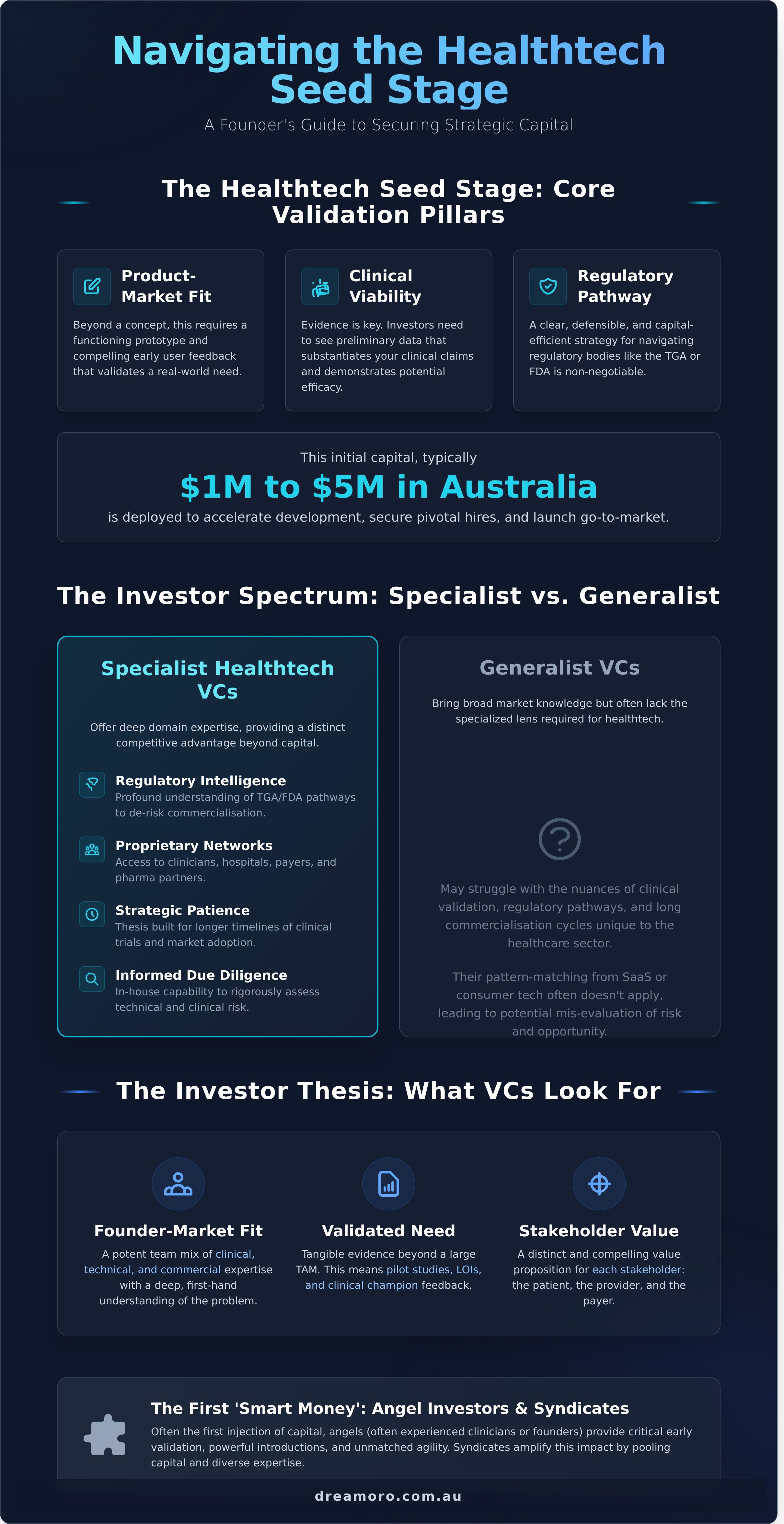
In healthtech, the seed stage is fundamentally about validation. Beyond a minimum viable product (MVP), investors expect to see evidence that addresses three core pillars: product-market fit, clinical viability, and a defensible regulatory pathway. Milestones often include a functioning prototype, compelling early user feedback, and preliminary data that substantiates clinical claims. This initial capital, typically ranging from $1M to $5M in Australia, is deployed to accelerate product development, secure pivotal hires in engineering and clinical affairs, and execute an initial go-to-market strategy.
Why Specialist VCs Outperform Generalists in Healthtech
While generalist technology investors bring broad market knowledge, specialist healthtech VCs provide the deep domain expertise essential for navigating the sector's unique challenges. Beyond capital, the strategic value offered by these specialist firms redefines the traditional venture capital relationship, providing a distinct competitive advantage.
- Regulatory Intelligence: A profound understanding of TGA, FDA, and other regulatory bodies to de-risk commercialisation pathways.
- Proprietary Networks: Established relationships with clinicians, hospital systems, payers, and pharmaceutical partners that accelerate market access.
- Strategic Patience: An investment thesis built around the longer timelines inherent in clinical trials and market adoption in healthcare.
- Informed Due Diligence: The in-house capability to rigorously assess technical, clinical, and scientific risk with precision.
The Role of Angel Investors and Syndicates
Often preceding institutional rounds, angel investors and syndicates represent the first injection of 'smart money' into a nascent healthtech venture. These investors are frequently experienced clinicians, seasoned industry operators, or successful founders who provide more than just capital. They offer critical early validation, make powerful introductions from their personal networks, and can move with an agility that larger funds cannot match. Angel groups and syndicates amplify this impact by pooling capital and diverse expertise, providing founders with a powerful advisory board from day one.
The Investment Thesis: What Top Healthtech VCs Are Looking For
Securing capital from top-tier healthtech VCs requires more than a compelling idea; it demands a meticulously constructed case that de-risks the investment at every critical juncture. Unlike conventional tech, healthcare is an ecosystem of entrenched systems, complex regulations, and multiple stakeholders. Specialist seed stage healthtech investors therefore apply a rigorous, thesis-driven evaluation framework designed to identify ventures with the resilience and strategic clarity to succeed in this challenging domain.
The evaluation dissects a startup's potential across several core pillars: the team's intrinsic capabilities, the market's validated need, the product's early traction, and its long-term defensibility. Understanding this thesis is the first step toward building a compelling investment narrative.
Assessing the Founding Team's 'Founder-Market Fit'
In healthtech, the founding team is the primary asset. Investors look for a potent combination of clinical, technical, and commercial expertise. This 'founder-market fit' demonstrates a deep, first-hand understanding of the problem and the credibility to engage with clinicians, hospital administrators, and regulators. We look for evidence of resilience, a clear vision for building a large-scale organisation, and the coachability to navigate the complex stakeholder maps inherent to healthcare.
Validating the Clinical and Commercial Need
A massive Total Addressable Market (TAM) is insufficient. Founders must demonstrate a specific, urgent, and validated need within a defined market segment. This is achieved not through assumptions, but through tangible evidence: pilot studies with clear endpoints, signed Letters of Intent (LOIs) from potential customers, and documented interviews with clinical champions. A powerful pitch clearly articulates the distinct value proposition for each stakeholder-the patient, the provider, and the payer. You can explore our investment thesis to see the specific market dynamics and themes we prioritise.
Demonstrating Early Traction and Product-Market Fit
At the seed stage, traction is rarely about revenue. It’s about demonstrating momentum and reducing risk. Meaningful traction can include:
- Positive outcomes from an initial clinical pilot.
- High user engagement and retention rates in a beta program.
- Enthusiastic, documented feedback from key opinion leaders (KOLs) in the field.
Showcasing a capital-efficient approach to reaching these milestones is paramount. Leveraging non-dilutive funding from sources like the NIH's SEED Fund to validate technology before a priced round is a powerful signal to seed stage healthtech investors. This demonstrates a disciplined strategy and an ability to execute on critical development pathways.
Preparing Your Pitch: A Healthtech Founder's Checklist
Securing capital from sophisticated seed stage healthtech investors requires more than a compelling idea; it demands a rigorously prepared, evidence-backed case for investment. Your ability to articulate a clear, defensible thesis across your pitch, financials, and diligence materials is what separates visionary founders from the rest. This checklist provides a strategic roadmap to ensure your venture is investor-ready.
Crafting a Compelling Healthtech Pitch Deck
Your deck is a narrative that must distill immense complexity into a clear, investable thesis. While the standard 10-12 slides (Problem, Solution, Market, GTM, Team, Ask) apply, healthtech demands unique focus. You must tell a powerful story about the clinical or systemic problem you are solving. For ventures leveraging advanced technology, such as those developing solutions that might be recognized by programs like the AI for Health Seed Grant, demonstrating technical depth on your 'Solution' slide is paramount. Most critically, your deck must transparently address your regulatory pathway and reimbursement model-these are not afterthoughts but core pillars of your business case.
Building Realistic Financial Projections
Experienced investors scrutinize the underlying assumptions of your model far more than a five-year revenue hockey stick. Your financial projections should be a direct translation of your go-to-market strategy, reflecting the often-lengthy sales cycles and complex stakeholder environments inherent in healthcare. For software-based models, key metrics are non-negotiable:
- Customer Acquisition Cost (CAC): How much does it cost to acquire a clinician, hospital, or patient?
- Lifetime Value (LTV): What is the total projected value of that customer?
- Use of Funds: Articulate precisely how this seed capital will be deployed to achieve specific, measurable milestones.
Navigating Technical and Clinical Due Diligence
The pitch meeting is the beginning; due diligence is where conviction is truly built. Be prepared with a well-organized data room containing all critical documents, from IP filings to key contracts. Expect deep dives into your technology stack, data security protocols, and architectural scalability. For any venture with a clinical component, your research methodologies, trial data, and evidence base must be meticulously documented and ready for expert review. This phase separates promising ideas from fundable companies. At Dreamoro Group, we guide the founders we back through this entire rigorous process, ensuring they are prepared to demonstrate both technical and clinical validity.
Beyond Capital: The Strategic Value of a Venture Partner
For founders navigating the complex landscape of early-stage funding, the calculus must extend beyond the capital offered. The most impactful seed stage healthtech investors are not merely financiers; they are strategic partners who provide a decisive, unfair advantage. The goal is to shift your mindset from seeking a transaction to forging a partnership that will fundamentally shape your company's trajectory and accelerate your mission.
What 'Smart Money' Means in Healthtech
In a sector defined by intricate regulatory hurdles and long commercialisation cycles, 'smart money' is capital infused with deep domain expertise. It represents more than financial backing; it's a gateway to an essential support system. This includes:
- Direct access to a curated network of hospital administrators, payers, and regulators.
- Strategic guidance on navigating complex reimbursement and go-to-market pathways.
- Support in recruiting specialist talent, from clinical affairs to regulatory experts.
- The invaluable credibility and validation that attracts future funding and enterprise partners.
The Venture Studio Model: Capital plus Capability
Evolving beyond traditional venture capital, the venture studio model integrates investment with hands-on operational support. This approach de-risks a startup's critical early stages by filling crucial talent and execution gaps. Founders gain access to embedded teams of specialists in engineering, product design, and commercial strategy, allowing them to build faster and more efficiently. Our Studio model is built on this principle, providing founders with the dedicated capability required to transform a vision into a market-ready reality.
Leveraging Your Investor's Ecosystem
A premier investor's value is magnified by the ecosystem they have cultivated. This network-spanning leading universities, clinical research organisations, accelerators, and corporate partners-becomes an extension of your own. The right partner facilitates critical introductions to key opinion leaders who can validate your technology and potential customers who can pilot it. An investor's portfolio can also create powerful collaborative opportunities, fostering synergies between companies solving adjacent problems. Dreamoro Ventures actively fosters these connections, creating a platform for accelerated growth.
Ultimately, when evaluating seed stage healthtech investors, the most critical question is not "How much can they invest?" but "How can they advance our mission?" The right venture partner provides the capital, capability, and connections necessary to navigate the unique challenges of healthcare innovation and build the future of healthcare.
Partnering to Build the Future of Healthcare
Navigating the path to seed funding requires more than a groundbreaking idea; it demands a sophisticated understanding of the landscape and a pitch meticulously aligned with a firm's investment thesis. The ultimate goal is not merely to secure capital, but to find a strategic partner who provides critical value beyond the term sheet. The right seed stage healthtech investors act as true partners, accelerating your go-to-market strategy and helping you navigate complex regulatory pathways.
At Dreamoro Group, we are more than just capital providers; we are company builders. As a specialist Healthtech VC and Venture Studio, our investment thesis is sharply focused on the technologies defining the future: AI-first platforms, preventative care, and digital therapeutics. Through our deep ecosystem partnerships with institutions like UNSW Founders, we provide founders with the intelligence and network required to build category-defining companies.
If you are building a company poised to redefine healthcare, we invite you to learn how Dreamoro Group partners with founders building the future of healthcare. The journey is challenging, but the opportunity to transform the industry has never been greater.
Frequently Asked Questions
Klaus Bartosch
CEO, Founder & Managing Partner