Key Takeaways
- Understand the economic and clinical imperatives driving the fundamental shift from a reactive sick-care system to a proactive healthcare model.
- Explore the core technologies powering the sector and identify how leading applications of ai in preventative health are creating tangible clinical and commercial value today.
- Uncover the compelling market dynamics and platform-level opportunities that establish preventative healthtech as a generational investment thesis for founders and VCs.
- Gain a strategic framework for navigating the complex regulatory, data, and go-to-market hurdles unique to building a capital-efficient venture in this space.

The narrative surrounding AI in healthcare has long been dominated by diagnostics-predicting disease from a scan, a slide, or a data point. While revolutionary, this focus overlooks a far more profound, capital-efficient shift: the transition from reactive treatment to proactive prevention. This is the domain of ai in preventative health, a generational investment theme that promises not just to treat sickness, but to engineer wellness.
But for the founders and investors building in this space, the path from algorithm to market is fraught with complexity. Beyond the technology, what are the viable business models? How can startups navigate the intricate regulatory and data privacy landscape? And most critically, what defines an investable opportunity that attracts specialist capital?
This analysis charts that new frontier. We will dissect the key applications defining the market, outline the success factors for founders seeking to raise capital, and provide a clear framework for building the ventures poised to lead the future of medicine.
The Paradigm Shift: From Reactive Sick-Care to Proactive Healthcare
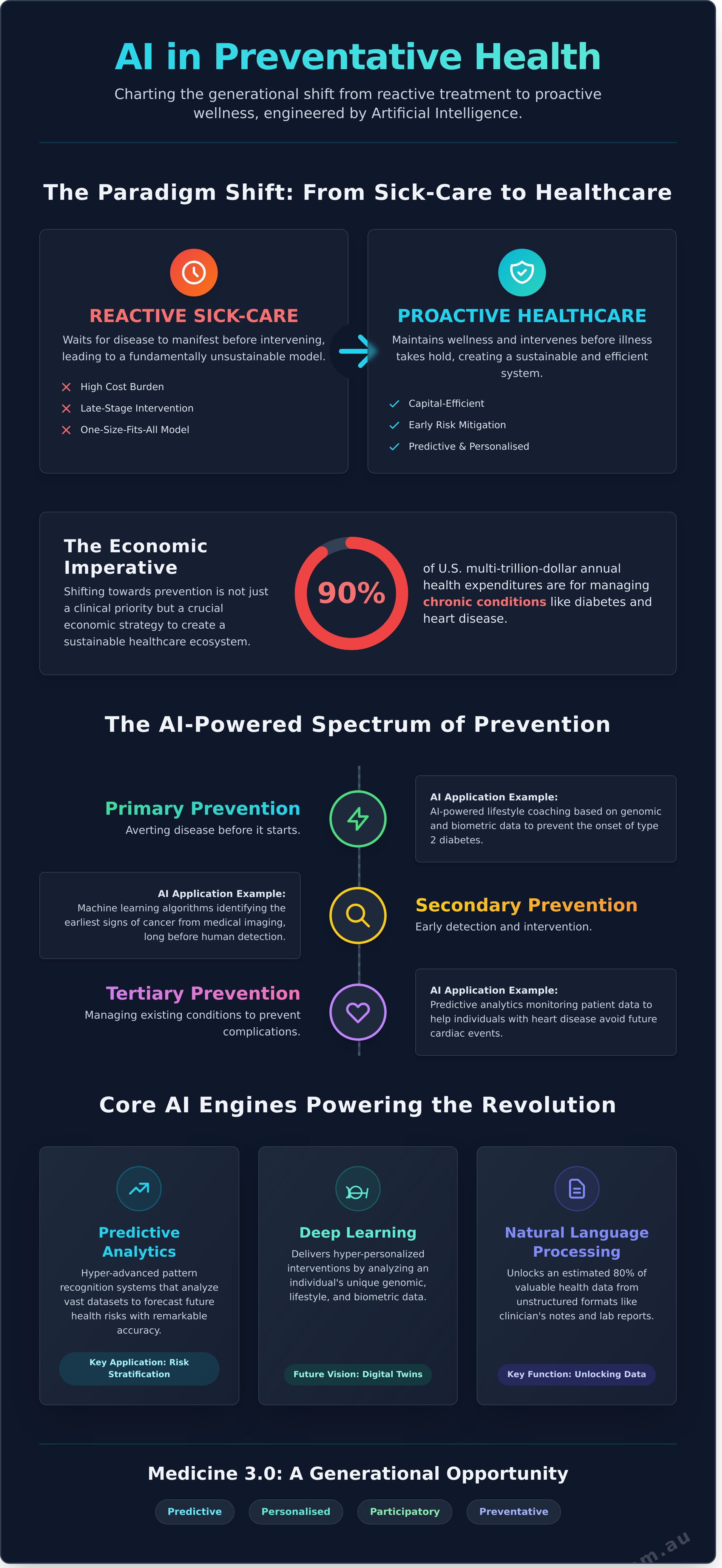
For decades, the global healthcare model has operated on a reactive footing-a system more accurately described as "sick-care." This approach, which waits for disease to manifest before intervening, is becoming fundamentally unsustainable against a backdrop of aging populations and escalating costs. The necessary evolution is a paradigm shift towards proactive, preventative health focused on maintaining wellness and intervening before illness takes hold. This is the next frontier, and artificial intelligence is the critical enabling technology required to deliver this new model of care at a global scale.
This evolution represents the rise of what we term 'Medicine 3.0'-a framework for healthcare that is predictive, personalised, participatory, and preventative. It moves beyond the one-size-fits-all model of the past, leveraging data and intelligence to create bespoke health journeys for individuals. The core thesis is simple yet profound: by understanding and mitigating risk early, we can unlock unprecedented gains in human longevity and systemic efficiency.
The Economic Imperative for Prevention
The financial burden of our current model is staggering. In the United States alone, 90% of the nation's multi-trillion-dollar annual health care expenditures are for managing chronic conditions like diabetes and heart disease. Shifting investment towards prevention is not just a clinical priority but an economic imperative. By identifying at-risk populations and intervening earlier, health systems can significantly reduce long-term treatment costs, creating a more sustainable and capital-efficient ecosystem for all.
Defining the Spectrum of Preventative Health
Prevention is not a monolithic concept; it operates across a multi-layered spectrum where the applications for ai in preventative health can drive innovation at every stage. The broad field of Artificial intelligence in healthcare offers tools to enhance efficacy across this full scope:
- Primary Prevention: Averting disease before it starts. Example: AI-powered lifestyle coaching based on genomic and biometric data to prevent the onset of type 2 diabetes.
- Secondary Prevention: Early detection and intervention. Example: Using machine learning algorithms to identify the earliest signs of cancer from medical imaging, long before human detection is possible.
- Tertiary Prevention: Managing existing conditions to prevent complications. Example: Predictive analytics that monitor patient data to help individuals with heart disease avoid future cardiac events.
Core AI Engines Powering the Preventative Revolution
The term 'Artificial Intelligence' is often used as a monolith, but in reality, it is a sophisticated suite of distinct computational technologies. To understand the strategic application of ai in preventative health, one must first grasp the core engines driving this shift. These systems are not magic; they are advanced mathematical models that require high-fidelity, diverse data as their fuel. When properly deployed, these technologies are transforming the practice of medicine from a reactive discipline to a proactive science.
Three disciplines form the vanguard of this transformation:
Predictive Analytics: Identifying At-Risk Populations
Think of machine learning models as hyper-advanced pattern recognition systems. By analysing vast datasets-from electronic health records to population-level social determinants-these models can forecast future health risks with remarkable accuracy. This enables a critical strategy known as risk stratification, where healthcare providers can identify individuals at high risk for conditions like diabetes or hospital readmission and allocate preventative resources before a crisis occurs.
Personalised Interventions with Deep Learning
If predictive analytics identifies the 'who,' deep learning addresses the 'what.' This more complex subset of AI moves beyond generic advice to deliver hyper-personalised interventions. It can analyse an individual's unique genomic, lifestyle, and real-time biometric data to craft tailored recommendations for diet, exercise, or medication. The most forward-looking application is the 'digital twin'-a virtual model of a patient used to simulate the effect of interventions and predict health outcomes with unparalleled precision.
Natural Language Processing (NLP): Unlocking Unstructured Health Data
An estimated 80% of valuable health data is unstructured, locked away in formats like clinician's notes, lab reports, and patient correspondence. Natural Language Processing (NLP) is the key that unlocks this intelligence layer. NLP algorithms can read, interpret, and structure this text-based data at scale, extracting critical insights that would otherwise be missed. A powerful use case is analysing patient journal entries or chatbot interactions to detect subtle linguistic markers indicating an early decline in mental health.
Tangible Applications: Where AI is Making an Impact Today
The theoretical promise of artificial intelligence is rapidly crystallising into a new class of investable, high-impact platforms. Moving beyond academic models, these applications demonstrate tangible value across the full healthcare value chain, from early-stage risk assessment to long-term disease management. This is where the investment thesis for ai in preventative health meets the market, showcasing a clear path to both clinical and commercial returns.
Early Risk Identification and Intelligent Screening
AI's core advantage lies in its capacity to identify subtle, predictive patterns within complex datasets far beyond human capability. This is creating a paradigm shift in early diagnostics. We now see algorithms that analyse retinal scans to predict cardiovascular risk with remarkable accuracy, a task previously requiring more invasive tests. In genomics, AI platforms are instrumental in decoding hereditary disease risks from vast genetic sequences, while AI-powered mammography is delivering earlier and more precise breast cancer detection, fundamentally improving patient outcomes and streamlining clinical workflows.
Hyper-Personalised Behavioural Change at Scale
A significant frontier is the scaling of personalised behavioural interventions. AI-powered digital therapeutics (DTx) are emerging as a capital-efficient platform to deliver care outside traditional clinical settings. Consider AI-driven applications that provide cognitive behavioural therapy to mitigate the risk of depression, or platforms that analyse real-time data from wearables to deliver precisely timed nudges for physical activity. This creates a continuous, adaptive feedback loop that empowers patients to sustain healthy habits.
Proactive Chronic Disease Management
For the millions living with chronic conditions, AI is transitioning care from a reactive to a proactive model. AI-enhanced remote patient monitoring (RPM) platforms are becoming critical infrastructure, preventing acute events before they occur. This shift is central to the future of AI in healthcare delivery, enabling systems to manage population health more effectively. For example, sophisticated models can predict hypoglycemic events in diabetic patients by analysing continuous sensor data, allowing for timely intervention. Furthermore, intelligent systems improve medication adherence through smart reminders, directly addressing a major driver of poor health outcomes.
The Investment Thesis: Why AI in Prevention is a Generational Opportunity
From a venture capital perspective, the shift from reactive treatment to proactive prevention represents a generational investment theme. For too long, healthcare has focused on sickness. We believe the most significant value creation in the coming decade will come from companies that keep people well, and the application of ai in preventative health is the primary catalyst. This is not just a moral imperative; it's a profound economic one, and it sits at the core of Dreamoro Group's vision to back the founders building the future of medicine.
Market Dynamics and Growth Projections
The market signals are unequivocal. The global preventive healthcare market is projected to grow into a multi-hundred-billion-dollar industry, propelled by powerful tailwinds. The systemic shift towards value-based care models incentivises outcomes over interventions, while the consumerisation of health empowers individuals to take control of their well-being. This paradigm shift is precisely what Our Investment Thesis targets, focusing on the platforms and intelligence layers that will define this new ecosystem.
What Makes a Preventative Health Startup Investable?
Not all preventative health startups are created equal. At Dreamoro Group, we look for a specific combination of attributes that indicate a high potential for impact and scale. Key markers of an investable company include:
- Strong Clinical Validation: A foundation built on rigorous, evidence-based science is non-negotiable.
- A Defensible Data Moat: A clear strategy for acquiring proprietary data and leveraging it to train unique algorithms.
- High User Engagement: A product that is not just used, but loved, driving sustained behavioural change.
Beyond these pillars, a viable and scalable business model that demonstrates a clear path beyond initial pilots is essential for long-term success.
Our Focus: Capital-Efficient, AI-First Models
We have a strong conviction in software-based, AI-first models. Unlike hardware-heavy businesses that require significant upfront capital, AI-driven platforms can scale globally with greater capital efficiency. These companies can refine their models, expand their reach, and deepen their impact exponentially with each new user and data point, creating a virtuous cycle of growth and defensibility. If you are a founder building a capital-efficient, AI-first company in this space, we invite you to connect with Dreamoro Group.
Navigating the Path to Market: A Founder's Playbook
The vision for leveraging AI in preventative health is compelling, but the path from concept to clinical adoption is fraught with unique and formidable challenges. Unlike typical tech ventures, healthtech founders must navigate a complex landscape of stringent regulations, deep-rooted clinical workflows, and intricate procurement cycles. Success requires more than a groundbreaking algorithm; it demands a disciplined, strategic playbook executed with precision.
Overcoming Data Privacy and Regulatory Hurdles
In healthcare, trust is non-negotiable. For founders in Australia, compliance with frameworks like the TGA is not an afterthought but a foundational requirement. Building a successful venture in this space necessitates a 'privacy-by-design' approach, integrating ethical data acquisition and robust, privacy-preserving AI techniques from day one. A culture of security isn't a feature-it is the bedrock of your entire operation.
Achieving Clinical Validation and Building Trust
There is a significant chasm between a wellness claim and a clinically validated outcome. To gain traction with clinicians and patients, your solution must be backed by rigorous evidence. This means moving beyond anecdotal success to structured validation through randomised controlled trials (RCTs) and the collection of real-world evidence. This clinical proof is the currency of trust, essential for driving meaningful adoption and demonstrating tangible improvements in health outcomes.
Driving Adoption with Superior Go-to-Market
Selling into complex healthcare ecosystems-whether through B2B channels to insurers and employers or directly to consumers-is a monumental task. The sales cycles are long, the stakeholders are numerous, and the value proposition must be crystal clear. Navigating this requires deep domain expertise and operational support. This is precisely where a hands-on partner like the Dreamoro Studio provides a decisive advantage, helping founders de-risk their commercialisation strategy and accelerate their path to market.
For the ambitious founders building the future of healthcare, these hurdles are significant but not insurmountable. With the right capital, expertise, and strategic partnership, the next frontier of AI in preventative health is within reach. Learn more about how we partner with early-stage companies at dreamoro.com.au.
From Thesis to Market: Partnering on the Preventative Health Frontier
The transition from reactive sick-care to proactive healthcare represents a fundamental market shift, powered by sophisticated AI engines. As we've explored, this is not a distant future; tangible applications are already demonstrating clinical and commercial value. The potential for ai in preventative health is no longer theoretical-it is a clear, present, and generational opportunity to build category-defining companies that will reshape human well-being.
For founders poised to lead this charge, navigating the complex journey from concept to market requires more than capital. It demands a strategic partner with deep domain expertise. As a Specialist Healthtech Venture Capital firm with an in-house Studio for Product Engineering & GTM and deep integration in the Australian healthtech ecosystem, Dreamoro provides the integrated platform necessary to succeed. Partner with Dreamoro to build the future of healthcare.
The next frontier of medicine is not just being discovered; it is being engineered. Let's build it together.
Frequently Asked Questions
Klaus Bartosch
CEO, Founder & Managing Partner